
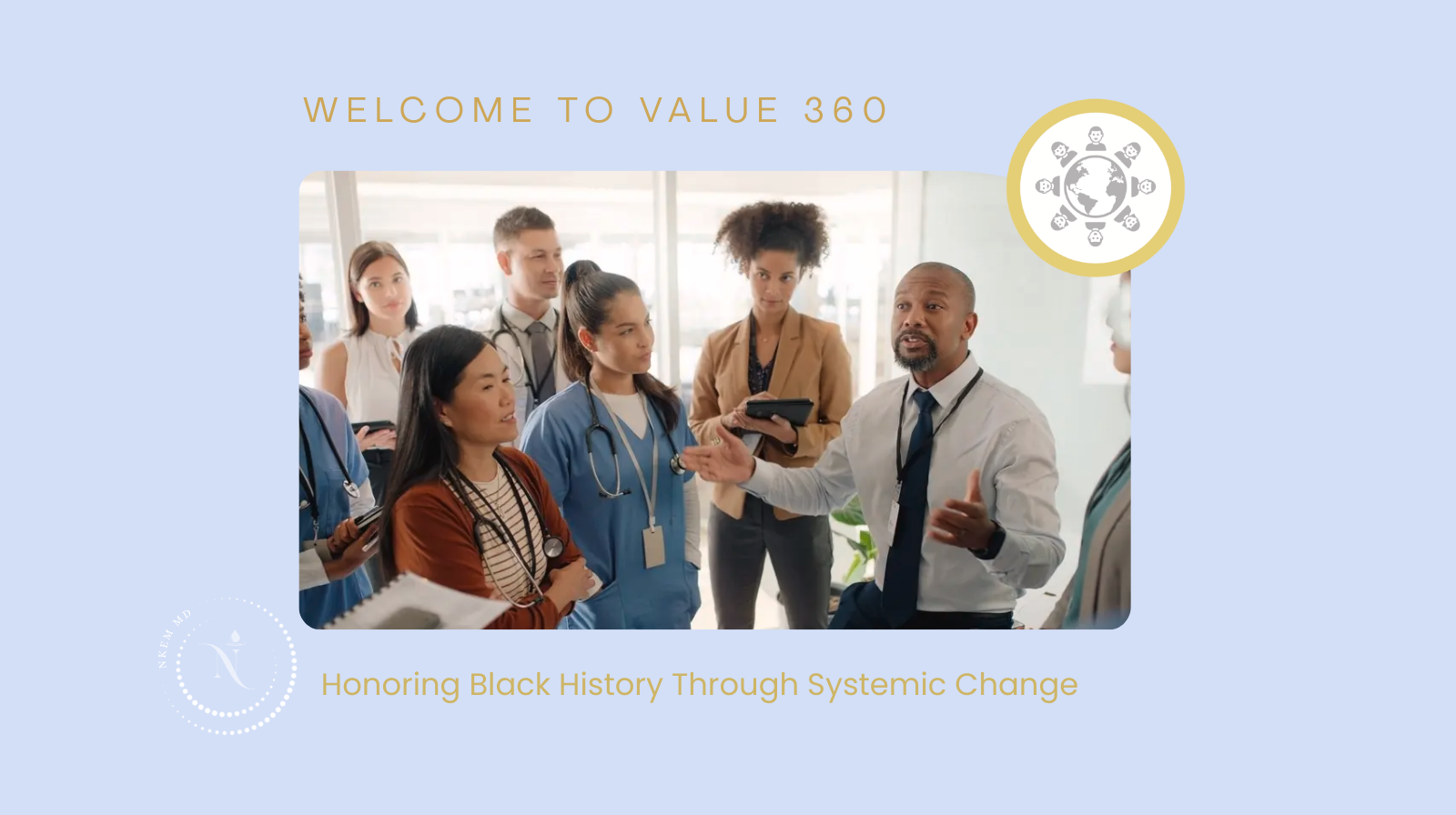
Black History Month is not only a moment of reflection — it is a call to redesign the systems that shape health, opportunity, and equity. It reminds us that inequities are not accidental; they are the result of structures built without the voices, experiences, and realities of Black communities in mind. And because inequity is built by systems, it must also be dismantled by systems.
Health Equity Is Not a Side Initiative — It’s a Leadership Decision
Decades of evidence show that entrenched disparities persist when leaders fail to design systems with access, trust, and lived experience at the center. Research highlights that hundreds of studies document suboptimal care among marginalized groups due to structural barriers, biased systems, and failures in culturally responsive communication. Strengthening leadership, accountability, and system design is essential to advancing equity. 1
Primary care access is a proven determinant of equity. The Journal of the American Board of Family Medicine notes that without universal access to high-quality primary care, improving national health outcomes and achieving equity becomes nearly impossible. Leadership choices determine whether primary care becomes a common good — or a gatekeeper that widens the gap.2
When leaders design systems without considering access, cultural relevance, community voice, trust, and historical context, disparities widen.
But when leaders design with intention, equity becomes operational.
Systemic Change Requires Systemic Solutions
Advanced Primary Care
High-quality primary care models reduce chronic disease disparities and improve population health when supported by intentional policies. National Academies research also underscores that primary care remains the only part of the system demonstrated to increase life expectancy at scale, making its equitable distribution critical. 3
Community-Based Models
Community-engaged strategies are essential to reducing disparities, especially among historically underserved populations. The CDC emphasizes that true progress requires collaborative strategies with communities, not for them — a core principle behind community-based participatory models.
Evidence also shows that community-based health education programs significantly improve health literacy, behavior change, and utilization of preventive care, with uptake increases as high as 65% in underserved groups. 4
Culturally Responsive Systems
Culturally congruent care improves patient trust, communication, and adherence. Research published in Nature highlights that language-concordant and culturally aligned care reduces readmissions and improves patient openness, especially among populations with limited English proficiency.
Additionally, qualitative health research shows that culturally responsive methodologies lead to more equitable health outcomes by challenging systemic biases and centering intersectional lived experience in system design. 5
These approaches are not aspirational — they are necessary for closing the gaps that persist in Black communities and other marginalized populations.
Our Commitment at Medicalincs
At Medicalincs, we help organizations redesign care models that close gaps — not reinforce them. Our work is rooted in evidence, community partnership, and system transformation.
- We integrate data-driven equity frameworks to identify and close disparities (as recommended by multi-stakeholder coalitions that successfully reduce inequities).
- We support organizations in strengthening primary care systems aligned with equity-focused policy recommendations.
Our Work Through Healthlincs
Through Healthlincs, we bring community-centered solutions directly to where people live, work, and gather — addressing structural inequities at their roots. This aligns with national models showing that cross-sector community-driven interventions can dramatically reduce maternal, child, and behavioral health disparities in underserved communities.
Our Work Through BIND Associates
Through BIND Associates, we engage in global efforts to design and implement sustainable health solutions that are culturally grounded and community‑led. By addressing structural inequities at their foundation, we deliver care solutions and healthcare financing education tailored to African communities—supporting stronger primary care systems and advancing women and youth development.
Addressing Disparities Begins with Leadership.
Are your systems built for everyone?
If you’re ready to operationalize a system that is built for everyone – not just discuss it – we’re ready to help you build systems that honor Black history not in words, but in structure.
[1] Joint Commission. Healthcare Disparities and the Role of Leadership in Advancing Health Equity. Oakbrook Terrace, IL: The Joint Commission Journal on Quality and Patient Safety. https://www.jointcommissionjournal.com
[2] Bazemore, Andrew, et al. “Primary Care and Health Equity.” Journal of the American Board of Family Medicine 31, no. 2 (2018): 178–181. https://www.jabfm.org
[3] National Academies of Sciences, Engineering, and Medicine. Implementing High-Quality Primary Care: Rebuilding the Foundation of Health Care. Washington, DC: National Academies Press, 2021. https://www.nam.edu
[4] Centers for Disease Control and Prevention (CDC). “Health Equity and Community Engagement Strategies.” Atlanta, GA: U.S. Department of Health and Human Services. https://www.cdc.gov
[5] World Journal of Advanced Research and Reviews. “Impact of Community-Based Health Education Programs on Preventive Care Utilization.” WJARR. https://www.wjarr.com
This entry was posted in Health & Wellness. Bookmark the permalink.